
After spending several days in the seaside town of Antibes, which is located in southern, Mediterrean France and exploring the darling towns of Menton, Eze and Villefranche-sur-Mer it was time for us to be on the move again. Our itinerary had us working our way up through some of Provence’s most culturally rich and naturally stunning sites. In this blog, read about us taking in the bold colors of the Léger Museum and exploring the peaceful grounds of Renoir’s estate. Then, about us wandering the cobbled charming streets of Saint-Paul-de-Vence, and seeing the wild beauty of the Gorges du Loup. If you’re looking to combine art, history, and nature into one unforgettable day, this itinerary from Antibes to Aix-en-Provence delivers.

Musée National Fernand Léger
Our first major stop on our road trop from Antibes to Aix-en-Provence was the Fernand Léger Museum, located just outside the quiet village of Biot. Fernand Léger, a 20th-century painter and sculptor, is best known for his bold, graphic style. He blended Cubism and modernism with industrial motifs and vibrant color. This museum was designed in collaboration with his widow, and it houses a large collection of his paintings, ceramics, stained glass, and monumental sculptures. Léger is an artist that I had only limited knowledge about. However, I was very excited to see his work up close because what I knew of him I loved, and the museum did not disappoint.


As soon as we walked up to the Fernand Léger Museum, I was struck by the massive mosaics covering the façade. They’re so bold and colorful that it feels like the building itself is part of the collection. These, combine with the Mediterranean sun shining down, the big beautiful trees, and the gardens wrapped around the museum, I was already loving this museum.


Inside the Léger museum
The museum really showcases so much of Léger’s work including different periods, styles and mediums. From Léger’s earlier, more Cubist-inspired works to his huge, vibrant canvases that practically hum with energy. He also created ceramics, murals, sculptures that show how much he believed art should live beyond just a canvas. Below are some of my favorite pieces.

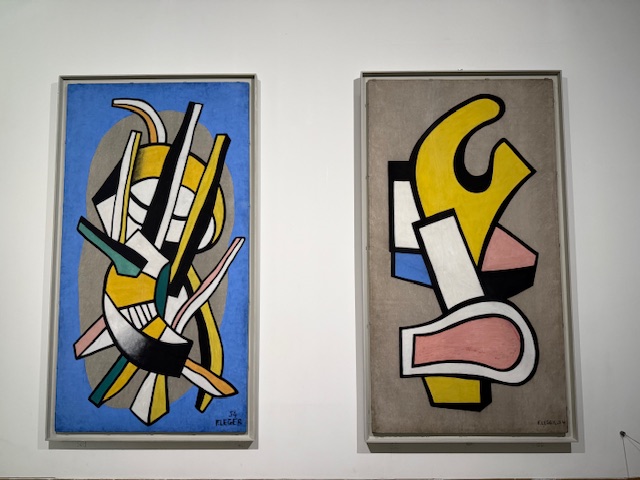


Upstairs on display is information all about Léger’s personal and professional life, offered in multiple languages. And then on display are some of his HUGE works of art. Le Transport des Forces is one of Léger’s largest masterpieces, measuring roughly 6.5 meters (21 feet) wide. There’s a display in the museum explaining how it was transported in sections and carefully installed inside. The painting captures the energy and movement of industrial and urban life, with Léger’s signature geometric forms, bold colors, and dynamic composition. It’s truly awe-inspiring in person and gives visitors a real sense of the scale and rhythm he aimed to convey. Other large paintings are nearby, including Les Constructeurs (The Builders). Also from the second floor visitors can see the large stained glass window that was also designed by Léger.


Sonia Delaunay at Musée Léger
When I visited this summer, there was also a temporary exhibition on Sonia Delaunay. She is a brilliant modernist whose love of color and geometric design paired perfectly with Léger’s work. I loved experiencing her art for the first time, so bright and joyful.


Visitor information about Léger Museum
The museum is open every day except Tuesday, from 10 a.m. to 6 p.m. in the summer. Tickets are €8, with discounts for students and free admission on the first Sunday of each month. Make sure to save time in your visit to explore the outdoor sculpture garden.


Cagnes-sur-Mer
After visiting the Fernand Léger Museum in Biot, our road trip from Antibes to Aix-en-Provence continued. We made a short 20 minute drive to Cagnes-sur-Mer. This charming Riviera town has both a seaside stretch and a medieval old quarter that is perched on a hill. We headed to the center of the old town and, after parking the car, wandered through the narrow streets in search of lunch. We found a sunny café and enjoyed a delicious lunch. After we picked up a small box of pastries from a local pâtisserie. With our treats in hand, we continued to the Renoir Museum. Okay, that’s a lie, we gobbled all the pastries down before we arrived. But look at them- can you blame us?


In the Footsteps of Renoir– Domaine des Collettes
Renoir’s former home, known as the Domaine des Collettes, is a 19th-century estate nestled among olive groves with sweeping views of the hills and the Mediterranean. Renoir moved here in 1907, seeking relief from arthritis in the region’s mild climate. Here he continued painting with the help of assistants and custom tools.

After parking and buying our tickets in the ticket office / bookstore, we walked the path to the homestead. The grounds are just as memorable as the house itself, and are open for wandering. There are wide lawns shaded by centuries-old olive and citrus trees, and paths that open up to views of the Mediterranean and the hilltop village of Haut-de-Cagnes. In front of the house is a beautiful flower garden, complete with a bronze statue entitled Venus Victrix. Exploring the grounds and garden felt like walking into a Renoir painting. It also served as a reminder that Renoir’s creativity stretched into his later years, including mediums outside of painting.


Inside the home, the rooms remain largely as they were when Renoir lived here. The house has been beautifully preserved and includes several of Renoir’s original paintings, photographs and family furnishings. One of the coolest things to see was his studio, complete with easel, wheelchair and silent film playing on the wall showing Renoir in action. Walking through the rooms feels intimate, as though the artist just stepped out for a moment.


Renoir’s atelier
Outside the home, visitors can step into Renoir’s atelier. There, light streams in through large windows onto easels, brushes and pigments that Renoir used towards the end of his life. There was much information about Renoir’s techniques, including about a paintbrush that would be tied to his hand when his arthritis made it difficult for him. In yet another outbuilding there was a special exhibition about Renoir’s sons: Pierre, Jean, and Claude. His children carried forward their own artistic pursuits, with filmmaker Jean Renoir perhaps the most famous of all.


Before leaving, we browsed the museum’s bookstore, which offers art books, catalogs, and prints, a perfect way to bring a little inspiration home (and trust me I did). The Renoir museum is open daily from 10am-1pm & 2pm-6pm, though it is closed Tuesdays off-season. Entry is €6, and free for children.
Saint-Paul-de-Vence – A Hilltop Village of Artists and Stone
Our mid-day stop on our way from Antibes to Aix-en-Provence was the legendary Saint-Paul-de-Vence. This was one of my favorite small cities we visited on our ‘Tour de France’ (and make sure to check out my other blog posts about this incredible road trip). Saint-Paul-de-Vence is a perfectly preserved, darling medieval village perched high above the Côte d’Azur. Famous for its stone walls, cobbled lanes, and artistic heritage, Saint-Paul has long drawn artists and writers. People including Chagall, Matisse, and James Baldwin found inspiration in its quiet beauty. After wandering the cobblestone streets, I understand why.

Exploring Saint-Paul-de-Vence
We parked just outside the medieval walls of Saint-Paul-de-Vence and, before even stepping inside, were struck by the view of the village rising on the hillside. Stone ramparts, tiled rooftops, and cypress trees set the scene. As we walked toward the gate, the lively sound of laughter and clinking metal greeted us; a group of locals was playing pétanque (known as bocce in some countries) on the shaded square.


After passing through the gate and arriving inside the village, the narrow cobbled streets wound upward past small shops and galleries. The village is compact and perfect for exploring on foot. There were some roads and alleys that were so narrow only one person at a time could make it through. Every corner revealed something beautiful- a carved doorway, pastel shutters, a burst of bougainvillea, a hidden courtyard.


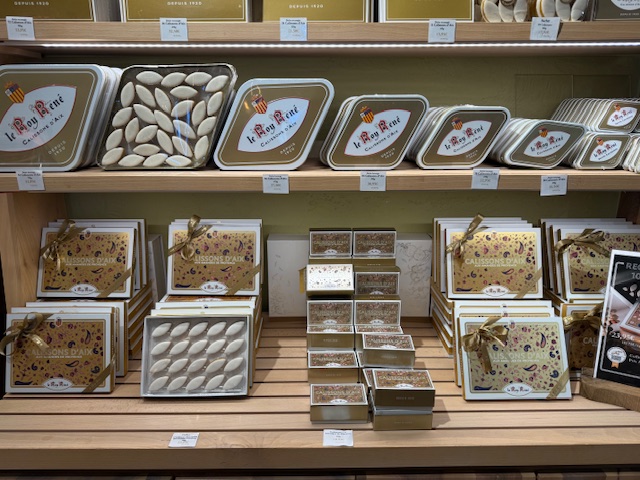
We stopped in lots of shops, browsing the handmade goods, sampling olive oils, candied fruit, and local wines offered by friendly shopkeepers. We couldn’t resist trying calissons, the diamond-shaped sweets made with almonds, candied melon, and orange peel, finished with a delicate glaze. Another specialty in the city and area is nougat. Some stores had huge blocks of nougats available for sampling and buying.


Fountains & ramparts
At the heart of the village, we paused at the Grande Fontaine, built in the 17th century. For centuries, this stone fountain was the center of daily life, where villagers came to collect water, wash laundry, and exchange news. Today, it still bubbles with fresh water and is one of the most photographed spots in town.

The ramparts of Saint-Paul-de-Vence are one of the most striking features of the village. They were built in the 16th century, around 1544, on the orders of King François I, making Saint-Paul one of the first villages in France to be fortified with walls. The fortifications were meant to defend the town against invasions during a turbulent period on the Franco-Savoyard frontier.

The walls form a complete loop around the old village, giving Saint-Paul its characteristic oval shape. Today, visitors can walk along stretches of the ramparts, especially on the southern side, where the views open wide over the valley, vineyards, and all the way to the Mediterranean. From above, you get not only the beauty of the landscape but also a clear sense of the village’s defensive layout.


Saint-Paul-de-Vence & art
Saint-Paul-de-Vence is as much an open-air gallery as it is a medieval village. For decades, artists, writers, and filmmakers have been drawn here by its light, scenery, and tranquil pace of life. Today, many painters and sculptors still exhibit in its winding streets. Even the cobblestones reflect this artistic heritage. As you walk through the lanes, you’ll notice mosaic designs set into the ground. This city was beautiful from the ground up.


Artist Marc Chagall spent the last decades of his life in Saint-Paul-de-Vence, drawn to the village’s light, quiet rhythm, and artistic atmosphere. He moved there in the late 1960s and lived until his death in 1985. Today, his presence is still felt in the village, from a shop window where a Chagall panting was on display, to his simple grave in the hilltop cemetery. There, visitors leave flowers and small stones in tribute to one of the 20th century’s greatest artists. And then just outside of the city walls a mural is visible just behind a school.


Leaving Saint-Paul-de-Vence, it was easy to understand why this village has captured the imagination of so many artists and travelers. Between the laughter of pétanque players, the tourists sitting around the Grande Fontaine, the taste of sweet calissons, and the unexpected moments of art, the town feels alive with beauty at every turn. It was definitely a town I would return to.
Gorges du Loup
As our final stop of the day as we made our way from Antibes to Aix-en-Provence, we drove inland to the Gorges du Loup, a dramatic river canyon known for its waterfalls, cliffs, and winding roads carved into rock. The drive itself is scenic and thrilling, with multiple pullouts for views and short hikes.

We visited the Saut du Loup, a stunning waterfall where you can pay a euro to access a panoramic path overlooking the gorge. If you’re feeling adventurous, there are canyoning and climbing activities available, some with the aid of local guides. I would have loved to explore the area more, but I was grateful for a brief visit. It was a refreshing change from the other stops earlier in the day. We enjoyed the views, the peace and quiet besides the sounds of rushing water.


Ending in Aix-en-Provence
By the time we pulled into Aix-en-Provence after leaving from Antibes in the morning, the sun was beginning to set. It was a day packed with art, history, and Riviera charm. From Léger’s bold modernism in Biot to Renoir’s peaceful atelier in Cagnes-sur-Mer, the cobbled lanes of Saint-Paul-de-Vence, and the rushing waters of the Saut du Loup, it was an incredible day all around. The scenic route from the coast into Aix would have taken around two and a half to three hours. We, of course, made lots of stops, but the drive also gave us time to reflect on all the amazing things we’d seen. Arriving in Aix felt like the perfect reward, and we still had lots planned in the days to come. Stay tuned for more posts about our incredible tour de France. Until then!
-Catching Katie


Leave a Reply