
If you’re new to Catching Katie, welcome! I’m Katie, and I have a serious obsession with travel and adventure. If you’ve been here before, you know that one of my favorite ways to explore is by visiting National Parks. I’ve been to quite a few, but one I’ve been wanting to explore for a long time is Acadia National Park. Over the past few Octobers, I’ve spent time in New England and loved seeing all the fall colors, so I planned a long weekend trip with a few friends to Maine to visit Acadia National Park. Keep reading for all my tips on how to spend two perfect days in Acadia National Park!
History of Acadia National Park
Acadia National Park, located on Maine’s Mount Desert Island, was officially designated as the 17th U.S. national park in 1919, making it the first national park established east of the Mississippi River. Its protection was the result of decades of effort by conservationists, local residents, and philanthropists, most notably John D. Rockefeller Jr., who donated land and funded the construction of the park’s iconic carriage roads. Fun fact- did you know the park was originally known as Lafayette National Park? It was renamed Acadia in 1929, honoring the region’s French heritage (et j’adore les français!) and the early Acadian settlers. Today, the park spans over 47,000 acres of rugged coastline. With forested mountains and serene lakes, it preserves both natural beauty and cultural history for generations to explore.

Know Before You Go
- Location: Acadia National Park sits on Maine’s Mount Desert Island, about 4.5 hours northeast of Boston, 1.5 hours from Bangor, or 4.5 hours from Manchester, NH, where we flew in from.
- Best Time to Visit: Visiting in late spring through early fall offers the best weather. Summer is the busiest, while September and early October bring cooler temps and fall colors.
- Park Entry Fee: Entry is $35 per vehicle for a seven-day pass (as of 2025). Or get a National Park pass (called America the Beautiful) for $80 a year and can get you into all the National Parks or places managed by the National Parks service.
- Where to Stay: Bar Harbor is lively and central with tons of options for lodging. Southwest Harbor offers a quieter, more local feel and is where we stayed during this trip.
- Tip: Start hikes early to avoid crowds and bring layers – coastal Maine weather can change quickly!

Reservation Guide: What to Book Ahead
Because Acadia is one of the most visited national parks in New England, several activities and areas require reservations during peak season:
- Cadillac Mountain Summit Road:
Vehicle reservations are required from late May through mid-October for anyone driving to the top. Separate time slots exist for sunrise and daytime access via Recreation.gov. Reservations sell out quickly, especially sunrise. However, hiking or biking to the summit is allowed without a vehicle reservation. - Campgrounds:
All park campgrounds- Blackwoods, Seawall, and Schoodic Woods- require advance reservations. No walk-ins are allowed. - Jordan Pond House:
A great option for dining at Acadia National is at Jordan Pond House, but dining reservations are highly recommended. Tables overlooking Jordan Pond often fill quickly during lunch and dinner hours. - Ranger Programs and Boat Tours:
Ranger-led hikes, island boat tours, biking tours, wildlife excursions and more usually require advance sign-ups due to limited capacity. You can sign up for them at ranger stations in the park, and read more about it here.
Our first day at Acadia
For our two day trip to Acadia National Park, my friends Tricia, Adam and I flew into Manchester, New Hampshire on Friday night. Because we arrived so late we drove about an hour, stayed overnight in NH and started early Saturday for the 4.5-hour drive to Acadia. After we arrived to the park, our first adventure was the Precipice Trail.
Hiking the Precipice Trail
The Precipice Trail is one of Acadia National Park’s most thrilling and iconic hikes. It is a steep, heart-pounding climb that rewards adventurers with breathtaking views of Frenchman Bay and the surrounding coastline. The trail ascends the face of Champlain Mountain using a series of iron rungs, ladders, and narrow ledges, making it feel more like a climb than a hike at times. Though it’s only about 1.6 miles one way, it can easily take a couple of hours to complete due to the vertical ascent and careful footing required along the cliffs. Not only that, but it offers adrenaline-pumping exposure along the way.

Parking for the Precipice Trail is located along Park Loop Road, but the lot is small and fills quickly, often before 8 a.m. So it’s best to start early or visit later in the afternoon. When we arrived there were lots of cars parked on the side of the road, so we joined in and pulled over before we even attempted the parking lot. Right from the start, the trail has lots of large boulders that need to be scrambled over. The route is marked with blue blazes that guide hikers up the main trail.


It’s important to follow the blue trail markings closely. But it’s never long before you’re climbing the next set of iron rungs. There are several sections with these rungs, and I was especially grateful for them – they were essential for hoisting myself up when the boulders were too far apart for my short legs. The effort was well worth it though. At the top, we were rewarded with incredible views of Frenchman Bay and the brilliant colors of Acadia’s changing fall leaves.


The summit of Precipice Trail
Reaching the summit of Champlain Mountain after climbing the Precipice Trail feels like a true accomplishment. The trail tops out at about 1,058 feet, making it one of the higher peaks on Mount Desert Island. At the summit, hikers are treated to panoramic views of Frenchman Bay, the Porcupine Islands, and the coastal forests below. The exposed granite ledges provide plenty of space to rest, enjoy a snack, and take in the sweeping scenery before continuing on.


There’s no single dramatic overlook signifying “the top” . Instead, the trail gently levels off, and you’ll find yourself walking across broad granite slabs with cairns and blue blazes marking the way. It’s a peaceful contrast to the intensity of the climb, and a great place to catch your breath while soaking up Acadia’s coastal beauty. From the summit, many hikers continue along the Champlain North Ridge Trail. However we took the option to connect to the Orange & Black Path to descend safely back to Park Loop Road.


The Precipice Trail is typically closed from late spring through mid-August to protect nesting peregrine falcons, so always check the park’s official website before heading out. Sturdy footwear is essential, and this hike should only be attempted in dry weather since the granite can become slick when wet or foggy. The trail is strenuous and not suitable for small children, pets or anyone uncomfortable with heights. But for confident and experienced hikers, the Precipice offers an unforgettable adventure and some of the most spectacular views in Acadia National Park. It was one of my top hikes during my two days in Acadia National Park.
Driving Park Loop Road
Another vital park of visiting Acadia National Park is driving Park Loop Road. Park Loop Road is a 27-mile scenic drive that passes many highlights, including Sand Beach, Thunder Hole, and Jordan Pond. Most of it is one-way, so plan to drive clockwise and allow a few hours if you want to stop at overlooks or short trails.


We drove along the Park Loop Road enjoying the views, and parking occasionally to watch the water crash on the granite and rocky coastlines.


Thunder Hole
We parked on the side of the road and enjoyed the views of the ocean before arriving to Thunder Hole, another must-see stop in Acadia. This natural sea cave gets its name from the deep, thunderous roar created when waves crash into the narrow inlet. When conditions are just right, usually a few hours before high tide, especially on windy days, water can shoot up as high as 40 feet, sending a misty spray over the viewing platform. We didn’t get to see that display, but we did get to hear it gurgle.


Otter Point, Cliff & Cove
Another worthwhile stop along Park Loop Road is Otter Point, located just past Thunder Hole. This stretch of coastline features some of the highest sea cliffs on the East Coast, rising nearly 110 feet above the Atlantic. The main overlook, known as Otter Cliff, offers breathtaking views of the ocean and the rocky shoreline below. Across the road, you’ll find Otter Cove, a quieter spot where the water is calmer and often reflects the surrounding evergreens. There’s a small parking lot at Otter Point, located right along Park Loop Road near the end of the one-way section. The lot has room for about a dozen cars, and it tends to fill up by late morning. While we were there we saw two different wedding photoshoots going on, so it’s clearly a popular stop.

Exploring Bar Harbor
After hiking, we explored the charming coastal town of Bar Harbor, the main gateway to Acadia National Park. This lively seaside community has local shops, seafood restaurants, cafés and bars. It’s a great place to unwind after a long day of hiking. The town sits on Frenchman Bay, offering beautiful waterfront views. From town, visitors can easily access boat tours, kayaking, and whale-watching excursions. In the evening, Bar Harbor has a warm, welcoming atmosphere and is busy with tourists seeking an opportunity to unwind. One of the more popular options is to enjoy a classic lobster dinner at one of the many restaurants. While I didn’t enjoy lobster during my time in Maine, my friend Tricia happily did!

Southwest Harbor
While Bar Harbor is a popular option for lodging, we stayed in Southwest Harbor, a quieter, cozy side of the island. It’s less touristy than Bar Harbor but full of charm, with local shops, art galleries, and waterfront views.


Day Two: Foggy Sunrises and Scenic Trails
We started before dawn for our Cadillac Mountain sunrise reservation, only to find the summit quickly shrouded in fog. Even so, standing above the clouds as the morning light shifted was unforgettable.


Cadillac Mountain is the tallest peak on Mount Desert Island, rising to 1,530 feet. It is also one of the most popular destinations in Acadia National Park and therefore essential during a two day visit. Its summit offers panoramic views of Frenchman Bay, Bar Harbor, and the surrounding islands. Cadillac is famous for being the first place in the United States to see the sunrise from October through March. It is a bucket-list experience for early risers and the reason why reservations are required.

Visitors can reach the summit by car via the paved Cadillac Summit Road. However, other options include hiking several trails ranging from moderate to strenuous, or even arriving by bike. The summit has a parking area, restrooms, and several viewing platforms accessible via short paths.
Beehive Trail
After experiencing the foggy sunrise atop Cadillac Mountain, we headed to the Beehive Trail. The Beehive Trail is one of Acadia’s most famous and exhilarating hikes. The trail gets its name from the distinctive beehive-shaped rock formation near the summit. Iron rungs and ladders wind up alongside the rock formation. When the hike gets busy, you can see all the “busy bee” hikers along the trails from the parking lot below.


Parking for the Beehive Trail is along Park Loop Road. However, the lot is small and fills quickly, especially in the morning. The trail is clearly marked with blue blazes, guiding hikers past tricky sections and toward the summit. Because of the exposed iron rungs and narrow ledges, it is a one-way hike. Hikers descend via the Ocean Path or Sand Beach area. Sturdy shoes and a steady pace are essential. And be prepared to pause and wait if other hikers are using the rungs- it’s part of the experience and ensures everyone can climb safely.

Hiking the Beehive
The climb begins with a steep ascent through forested terrain, quickly leading to rocky ledges and narrow passages. Because the trail is exposed in sections, we had to stop and wait at times while other hikers navigated the iron rungs. This did, however, add a bit of a social element to the adventure. The Beehive is one of the most popular hikes at Acadia, so even though we arrived around 7:30 a.m., the trail was already busy.


I thought some of the rungs were closer to the edge and there were more narrow walkways than at the Precipice Trail, but my friends disagreed. Either way, I loved it! It was at times thrilling, a bit challenging, but just overall a very fun hike with beautiful views.


After some climbing, waiting, scaling, waiting and scrambling some more, we reached the summit. And the effort was completely worth it. Not only were the views gorgeous along the the way, but from the top, we had panoramic views of Sand Beach, Frenchman Bay, and the rolling peaks of Mount Desert Island.

The combination of the challenging climb, the unique beehive rock formation, and the stunning vistas makes this trail an unforgettable experience. At the top we took a break, enjoying a snack and a toast in memory of Adam’s mother. It was a lovely way to start the morning.


On the descent, we took our time to enjoy the scenery, snap photos, and appreciate the dramatic contrast between the forested cliffs and the serene shoreline below.

Sand Beach
No trip to Acadia National Park is complete without a stop at Sand Beach, one of the park’s most beautiful and unique coastal spots. And it’s located right next to the parking lot for the Beehive, so after our hike we walked down to explore it on our own. Nestled between rocky headlands, this small crescent of soft sand stretches only about 290 yards, but it’s the park’s only ocean beach accessible by car. The sand here is made up mostly of crushed seashells, giving it a lighter, almost pinkish hue. Despite its inviting appearance, the Atlantic water stays chilly year-round, rarely rising above 55°F! While some may be brave enough to go swimming in the summer months, I only stuck my hand it. It was great looking at the coastline and noting where the tide rises to.


Sand Beach is a popular starting point for several great hikes, including the Beehive Trail and Ocean Path, which follows the coastline to Otter Cliffs. Early morning is a wonderful time to visit, when the light is soft and the crowds are fewer.
Parking and shuttles in Acadia
Parking can be limited at popular trailheads like the Beehive, Precipice, and Jordan Pond. Therefore, arriving before 9 a.m. gives the best chance of finding a spot. We parked our car at the Beehive lot at 7:30 and decided to keep it there all day and use the shuttle to explore the park. The Island Explorer Shuttle is a free seasonal service connecting Bar Harbor, campgrounds, trailheads, and park destinations. There were even stops out by where we were staying in Southwest Harbor. It’s a great alternative to driving and hunting for parking.
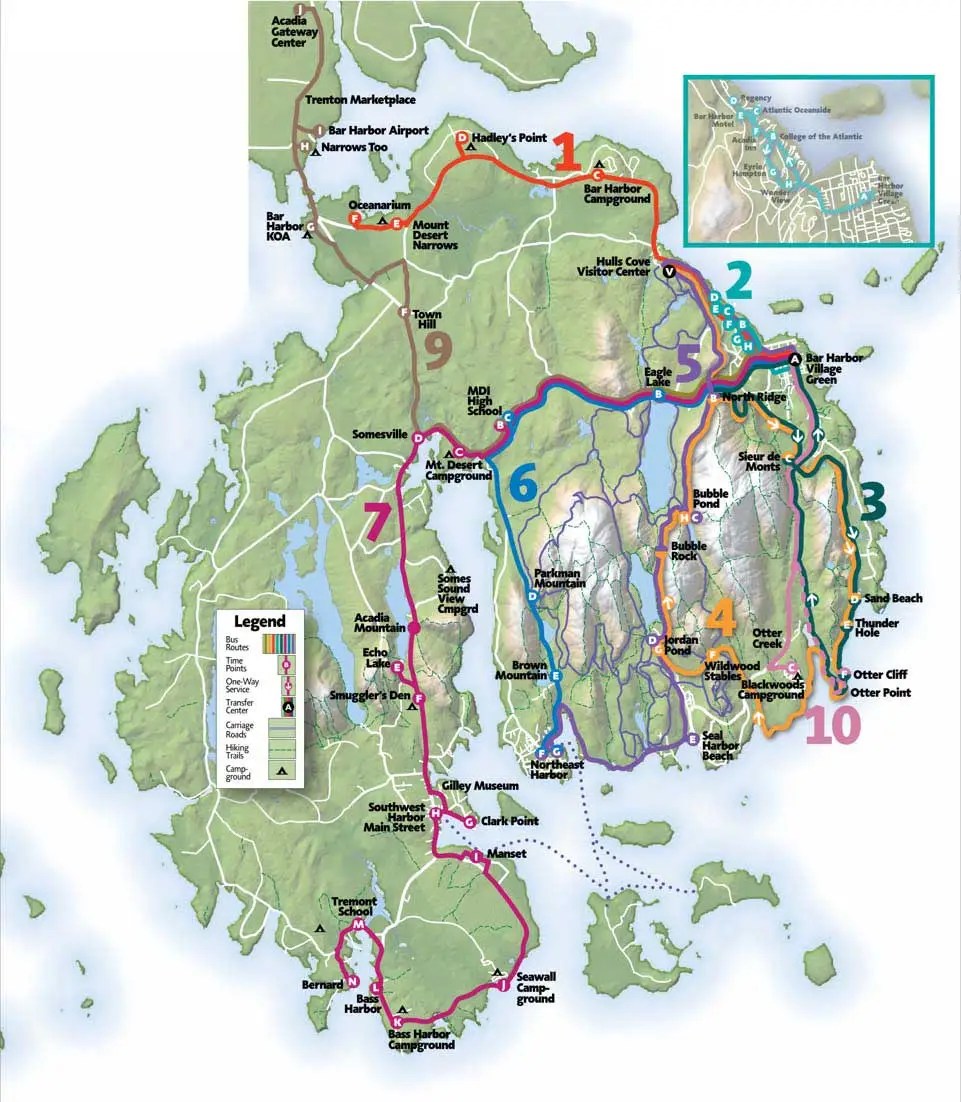

All the drivers we met while we were there were super friendly. They really made sure to help the visitors get where they need to go, including coordinating with other drivers and radioing in info about the shuttle riders. Super impressed by their efforts! There are several shuttle routes, and the map tells you exactly when they will arrive at a destination and how long it takes to get to a stop. I definitely recommend it for getting around Acadia National Park.
Acadia National Park Visitor Centers
Our first destination once we were aboard the shuttle was a visitor center, so we could get our obligatory National Park stamps and a few souvenirs. There are two visitor centers at Acadia National Park:
- Hulls Cove Visitor Center:
The main visitor center is located near Bar Harbor. It offers maps, exhibits, trail conditions, and ranger guidance for visitors. There is a small store for buying all your NP souvenirs. - Sieur de Monts Spring Area:
The Sieur de Mont Spring Area is home to the Abbe Museum, a nature center, and Wild Gardens of Acadia. This area provides insight into the park’s cultural and natural history.

After visiting the Hulls Cove Visitor Center, we took the shuttle back towards Jordan Pond House to do a bit more hiking. We got off at the Bubbles Pond stop in order to hike the Pemetic Mountain Trail, but first we walked along part of the Acadia National Park’s carriage roads.
Carriage Roads and Bubble Pond
One of the most unique features of Acadia National Park is its network of Carriage Roads. These roads are system of 45 miles of crushed-stone pathways that wind through the park’s forests, valleys, and around its lakes. These historic roads were built between 1913 and 1940 by philanthropist John D. Rockefeller Jr. He wanted to create a way to explore the park without automobiles. Today, the Carriage Roads are used for walking, biking, horseback riding, and even cross-country skiing in the winter. The roads are beautifully maintained, complete with stone bridges and scenic overlooks.


One of the most scenic stops along the Carriage Roads is Bubble Pond. This quiet, mirror-like lake is nestled between North and South Bubble Mountains. It’s a great place to start a gentle (or electronic) bike ride or to go for a leisurely walk. There’s a small parking area along Park Loop Road (as well as the bus stop), and from there, a short path leads to the pond. The area is calm and less crowded than some of the park’s other lakes, making it a perfect spot to relax or capture some photos. On my next trip to Acadia I plan on bringing my hammock and relaxing right by it.

From Bubble Pond, we continued our adventure by hiking Pemetic Mountain, which offers a completely different perspective of Acadia’s landscape.
Hiking Pemetic Mountain in Acadia National Park
Our next adventure was Pemetic Mountain, one of Acadia’s most underrated hikes. However, it was recommended and it was a hike I absolutely loved! We started from the Bubble Pond Trailhead and followed the Pemetic Northwest Trail, a 3.2-mile round trip with about 1,250 feet of elevation gain. Unlike the steep iron rungs of the Beehive and Precipice Trails, Pemetic offered a quieter, more gradual climb. But it was still a climb and there was still come scrambling involved!


This hike felt more peaceful than the others. Instead of clinging to cliffs, we moved steadily upward along open rock slabs surrounded by vibrant fall colors. The trail winds through forested sections before opening up to wide granite ledges and sweeping views. At times the forest was so green and mossy that it resembled a fairy garden. And then the forest gave way to incredible views of Jordan Pond, Bubble Pond, and Eagle Lake shimmering below. The climb was steady but never overwhelming, and the mountain’s openness gave us plenty of time to pause and take in the scenery.


Views from the Summit of Pemetic Mountain
From the summit, the panoramic views were stunning. We could see Cadillac and Dorr Mountains in the distance. And thanks to my trusty binoculars we could even spot Bubble Rock perched on South Bubble Mountain. The clear, crisp air and colorful foliage made this one of the most rewarding moments of our trip.


The descent toward Jordan Pond was gentler, leading us to the scenic Jordan Pond Path. The still water reflected the North and South Bubble Mountains, creating a picture-perfect ending to the hike. Pemetic Mountain may not have the thrill of ladders or cliff edges, but it offered something better- quiet beauty, big views, and fewer crowds.

Bubbles
I’m mentioned Bubbles a few times- so maybe you’re wondering what these are! The North and South Bubbles are two small but striking mountains near Jordan Pond. Their rounded, “bubble-like” shape is how they got their nickname. From the trails on the Bubbles, you can enjoy sweeping views of Jordan Pond, Pemetic Mountain, and the surrounding Carriage Roads. The South Bubble is home to the famous Bubble Rock, the giant glacial boulder perched near the summit. Hiking the Bubbles is a popular way to see some of Acadia’s most iconic scenery in a relatively short walk. I didn’t get to do it- it’s on my list for next time!

Jordan Pond Path
After descending Pemetic Mountain, we joined the Jordan Pond Path, one of Acadia’s most peaceful and scenic walks. The trail loops around the pond for about 3.5 miles and offers calm water views framed by the North and South Bubble Mountains. We didn’t have time to walk the full loop or reach Bubble Rock, which I had hoped to see, since we had reservations to keep.

So, we settled for just following part of the path along the shoreline. We found a quiet bench, relaxed with the drinks we had packed, and enjoyed the reflections of the fall colors on the still water. This area was also one of the busiest spots we visited during our two days in Acadia National Park, along with the Beehive Trail and the Park Loop Road. It is a great option for people who have mobility concerns. It was a beautiful area and provided a nice contrast to our more challenging hikes earlier in the trip.


Dining at the Jordan Pond House
Before leaving the area, we had reservations at the Jordan Pond House, one of Acadia’s most famous spots. We sat outside on the lawn overlooking Jordan Pond. Even though it was a little breezy and chilly, it was the perfect place to relax after a full (early) day of hiking.

Adam and Tricia couldn’t resist ordering the famous popovers- light, airy pastries served warm with butter and jam. They also enjoyed the lobster stew, while I had a bowl of clam chowder (gluten free!). The Jordan Pond House serves a variety of meals, coffee, tea, and even alcoholic beverages. The atmosphere is casual yet special, surrounded by nature and history, as the restaurant has been welcoming visitors since the late 1800s.


Reservations are highly recommended, especially during peak season or weekends. They can be made online through the Jordan Pond House website or via OpenTable. Tables fill quickly, so booking a week or two in advance is the best way to secure a spot, especially if you want one of those coveted outdoor tables with a pond view. For those without reservations, there’s also a walk-up window where you can order popovers, drinks, or light bites to enjoy outside on the lawn. It’s a great option if you want to experience the view and the famous popovers without waiting for a table.
The Jordan Pond Gatehouse
Just down the road from the Jordan Pond House sits the Jordan Pond Gatehouse, one of the most photographed spots in Acadia National Park. Built in 1932, the stone building once served as an entrance to the Carriage Roads. The gatehouse was designed by John D. Rockefeller Jr., who helped create the entire Carriage Road system.

Its twin stone towers and arched passageways look like something from a fairytale. You can’t go inside the gatehouse, but you can walk or bike past it to admire the design up close. It’s one of those special spots that perfectly captures the history and beauty of Acadia. Before eating at the Jordan Pond House, we walked along the nearby Carriage Road for a bit. The path was peaceful and quiet, and we even saw two horse-drawn carriages pass by, adding to the old-fashioned charm.


Horseback & Carriage Rides
If you want to experience the roads like travelers did a century ago, you can book a guided carriage tour or horseback riding trip through Wildwood Stables, located inside the park near Jordan Pond. The stables offer a variety of carriage rides and horseback experiences, from short scenic loops to longer excursions. The tours are seasonal, typically running from late spring through mid-fall. In winter, those same roads are popular for cross-country skiing and snowshoeing.


Other Activities in Acadia National Park
And speaking of other activities at Acadia National Park, there are so many things to do besides hiking. Here is my list of things I need to do on my next trip to Acadia (and there will be another trip!)
- Biking: You can explore the park on two wheels along paved and scenic roads outside the Carriage Roads system. Rentals are available in Bar Harbor or Southwest Harbor, making it easy to see more of the park in a few hours.
- Lighthouses and Light Stations: The Bass Harbor Head Light Station is a must-see. Perched on rugged cliffs, it’s especially beautiful at sunset and perfect for photos. Other smaller lights dot the coast, but this one is the iconic stop for most visitors.
- Wildlife Watching: Keep an eye out for white-tailed deer, bald eagles, and harbor seals. Sunrise and sunset are the best times to spot animals and capture the park’s beauty.

Water Activities in Acadia National Park
Water is a big part of the Acadia experience. With miles of rocky shoreline, sparkling lakes, and open Atlantic views, there are plenty of ways to enjoy it:
- Kayaking and Canoeing: You can rent a kayak or canoe for a paddle on Jordan Pond or Eagle Lake. Sea kayaking along the coast is also a fun option. Keep an eye out for seals, porpoises, and seabirds. Guided tours are available if you want a little extra help or insight.
- Puffin and Whale Watching Cruises: From Bar Harbor, you can take guided boat tours to see wildlife. Puffin cruises in spring and summer give you a chance to see Atlantic puffins and other seabirds. Whale-watching trips let you spot humpbacks, finbacks, and more. Advance booking is recommended, especially during peak season.
- Ferry to Nova Scotia: During the summer months, you can take a ferry from Bar Harbor to Yarmouth, Nova Scotia. This is a longer excursion, perfect if you want to combine your Acadia trip with a quick international getaway. Reservations are highly recommended.
- Swimming: If you’re brave enough, you can take an ocean swim at Sand Beach. For calmer freshwater swimming, Echo Lake Beach is perfect, with mountain views in the background.
- Tidepooling and Bar Island Sandbar Walk: At low tide, tidepools along the shoreline are fun to explore. I didn’t get to do it on my trip, but several friends recommended it! Just make sure to check the tide charts and get back before the water comes in!

Where to stay
While the park doesn’t have traditional National Park lodges, Blackwoods, Seawall, and Schoodic Woods campgrounds provide tents and RV sites. For those staying several days at Acadia, the nearby Bar Harbor and Southwest Harbor offer inns, cabins, and B&Bs for those preferring a more comfortable stay (like me!
Other Popular Hikes in Acadia
Okay, but we can’t ignore one of my favorite things in life- hiking! And there were more hikes at Acadia National Park that I didn’t get to experience during my two days there. Beyond the Precipice, Beehive, and Pemetic, and Jordan Pond, Acadia offers trails for all skill levels:
- Gorham Mountain is a moderate 3.5-mile loop with a few rocky spots where you have to shimmy through narrow crevices. It may not be as intense as The Precipice or The Beehive, but it adds a fun bit of adventure. The trail rewards you with stunning views of Sand Beach, Frenchman Bay, and the surrounding coastline
- Beech Mountain and Great Head Trails are moderate-to-challenging hikes, about 2.5 to 3 miles each, with dramatic ocean vistas. These trails are perfect if you want a mix of exercise and incredible scenery.
- Cadillac Mountain South Ridge is a less intense alternative to the Precipice, about 7 miles round trip if you do the full loop. The hike leads to the summit with panoramic views of the park and surrounding islands.
- Ocean Path is a flat, easy trail along the shoreline from Sand Beach to Otter Cliffs, roughly 4 miles round trip. It’s perfect for tidepooling, leisurely walks, and enjoying the coastal scenery without a strenuous climb.
With over 120 miles of trails at Acadia National Park, there’s something for everyone, from beginners to seasoned hikers.

Reflections on Our Two Days in Acadia
Even in just two days, Acadia delivered adventure, stunning scenery, and a true taste of Maine’s charm. From the Precipice Trail to the foggy Cadillac summit and the calm waters at Jordan Pond, every moment felt special. Have you been Acadia National Park? What recomendations do you have? I’d love to hear from you. And thanks for visiting catchingkatie.com Catch you later!
-Catching Katie


Leave a Reply